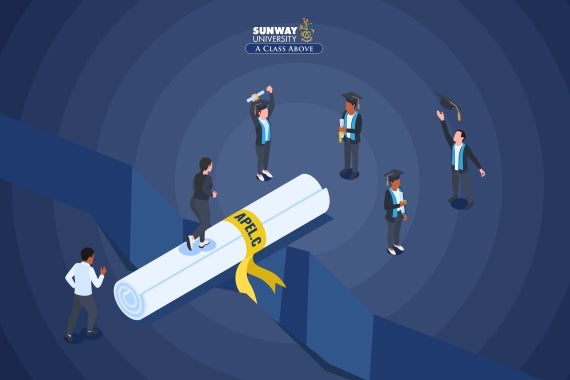
What Is APEL.A: An Alternative Pathway to Postgraduate Study

APEL.A is an accreditation pathway that lets Malaysians access higher education using work experience in place of a formal academic qualification, and it is becoming more relevant by the year.
The Department of Statistics Malaysia’s Q1 2026 Labour Market Review shows that skill-related underemployment affected 35.2% of tertiary-educated employees, while Human Resources Minister Steven Sim stated back in 2024 that 600,000 workers across 10 key sectors would need reskilling within three to five years as AI, digitalisation, and the green economy reshape their industries. For many mid-career professionals, the gap holding back a promotion or a career switch may not be ability, but a missing piece of paper.
What is APEL.A?
APEL.A stands for Accreditation of Prior Experiential Learning for Access, a process established by the Malaysian Qualifications Agency (MQA) under the Malaysian Qualifications Framework. It recognises the value of experiential learning, allowing individuals without traditional academic qualifications, but with relevant work experience, to gain entry into a tertiary-level programme of study.
This is not a shortcut. Rather, it's a formal, MQA-regulated evaluation of your professional and life experience against the learning outcomes of your chosen programme. Sunway University is recognised by MQA as an APEL assessment centre with “internal” status (PPA Dalaman), meaning learners who complete their APEL.A pathway through Sunway go on to pursue their chosen programme exclusively at the university.
APEL.A is one of four APEL types offered under the Malaysian Qualifications Framework, alongside APEL.C (credit award), APEL.Q (qualification award), and APEL.M (micro-credential accumulation). To learn more about the other types of APEL and compare all four before deciding your goals, head here to view all our articles under the APEL category.
Who Can Apply for APEL.A?
APEL.A suits working adults who have built real capability on the job but lack the certificate to show for it. You're likely a strong candidate if:
- You have relevant work experience but no formal qualification to access the tertiary-level programme you want
- You've completed vocational or professional development training that isn't formally recognised for university entry
- You're returning to study after a break and don't want to restart from an entry-level qualification
- You're eyeing a career switch into a field where your transferable skills outweigh your paper credentials
Age and prior qualifications matter too, and requirements scale with the level you're applying for:
- APEL.A T-3 (Certificate level): At least 19 years old, Malaysian, with relevant work experience
- APEL.A T-4 (Diploma level): At least 20 years old, Malaysian, with relevant work experience
- APEL.A T-6 (Bachelor's level): At least 21 years old, Malaysian or international student with relevant work experience
- APEL.A T-7 (Master's level): At least 30 years old, Malaysian or international student with relevant work experience and an STPM, Diploma, or equivalent qualification
Notably, applicants whose highest qualification is a Diploma or STPM must be at least 30 years old to apply for postgraduate entry via APEL.A T-7. This is the level most relevant to working professionals eyeing a master's degree.
How the APEL.A Application Process Works
The journey runs in three broad stages, and understanding the pace helps you plan around your work commitments:
- Application (around six weeks): Register on the MQA portal and select your chosen university as your assessment centre. Complete the self-assessment form, pass the entry screening, settle the enrolment and assessment fees, then attend orientation and a session with your assigned APEL advisor.
- Assessment (up to around 10 weeks): Sit the aptitude test, which covers numerical literacy, English literacy, Bahasa Malaysia literacy, and general knowledge or critical thinking. Once you pass, submit your portfolio of evidence for evaluation. T-7 (Master's level) applicants also go through an interview.
- Results (around five weeks): Once your portfolio is assessed and endorsed, MQA issues your APEL.A certificate, and you can proceed with admission to your chosen programme.
A few practical details worth knowing before you start:
- Portfolio decisions are typically issued within 20 working days of a completed submission.
- You may re-sit the aptitude test a maximum of two times, with a 3-month cooling-off period between attempts.
- If you want to add evidence after submitting your portfolio, you'll need to wait six months before resubmitting.
- Assessment fees follow MQA's published structure and scale by level, from around RM 240 for Certificate and Diploma levels up to RM 560 for Master's level.

Using APEL.A to Advance or Switch Careers Without Starting Over
This is where APEL.A earns its keep for mid-career professionals specifically. Rather than forcing you to re-enter the education system from scratch, APEL.A T-7 lets you apply directly for postgraduate entry, provided your work experience demonstrably meets the programme's learning outcomes.
That distinction matters if you've spent a decade or more building seniority in your field. Instead of stepping backward to earn a basic qualification, you’re converting the expertise you already have into direct access to a master's-level programme.
This also makes APEL.A a genuine option for an industry switch, not just a promotion within your current field. If you're moving from, say, operations into a data-driven or people-management discipline, your portfolio can draw on transferable skills, cross-functional projects, and leadership experience rather than requiring a subject-specific undergraduate degree first.
At Sunway University, APEL.A applicants who qualify at T-7 (Master's level) can move directly into any of our 100% online master's programmes, which are all MQA-accredited and built for working professionals who want to keep earning while they study.
Is APEL.A the Right Next Step for You?
APEL.A exists because Malaysia's higher education system recognises that learning doesn't only happen in a classroom. If you have the work experience but not the certificate, it's a legitimate, MQA-regulated way to close that gap and move directly into postgraduate study, whether that's a step up in your current field or a deliberate switch into a new one.
Ready to find out if your experience qualifies? Speak with our Education Counsellors to map out your eligibility and next steps.